Showing posts with label food. Show all posts

Saturday, July 9, 2016

Grocery Haul: July 1st, 2016 and the grocery savings and rebate apps I love

Paying It Off One Penny at a Time: July 1, 2016 Grocery haul and the savings and rebate apps I love
I happen to LOVE grocery haul videos on YouTube! I don't know why, but they get me kind of excited. I really like seeing how other people eat and what groceries in different areas of the country and at different stores cost compared to my own.

I'm not quite at the taking video stage yet, but I plan to get there. In the meantime, here is my grocery haul (well, part of it) from July 1st, 2016. I made a few additional stops over the last few days for more produce and staples that were cheaper elsewhere, but this gives you a basic idea of some of what we eat.

Please note, we are a family of two--a mom and a teenage boy. We also buy most of our produce separately at different stores so not a lot of produce is pictured here.

The apps I mention below are (please note, some are affiliate links):


and the website I print my coupons from is:

  • Swagbucks -- Go to the Shopping tab in the menu and then find the link for grocery coupons. With Saving Star, you get points for redeeming coupons. These points, along with points accrued from other activities via Swagbucks, can be redeemed for giftcards. Over the last several years, I have paid for my son's birthday and Christmas presents almost entirely with giftcards earned in this manner. Most months, I am able to earn an average of $20 in Amazon gift cards via Swagbucks. Sometimes I earn a bit more and sometimes I cash out for Starbucks gift cards instead. You can earn a lot more on Swagbucks, but it can be time intensive if you aren't picky. It can also generate a lot of unnecessary junk email if you aren't careful.  

Most of these apps and the website are only available to users in the USA, although I believe Checkout 51 is also available in Canada.

Since that haul, I did temporarily misplace my receipts so I am not totally sure of how much I spent or what my savings were overall, but I recall being pleased other than a hiccup with three coupons that I mention below. On average, I save 30 to 50% per grocery trip BEFORE applying rebate app savings. On occasion I get up to 75% savings. My dream, of course, is a 100% savings trip!

On to the haul...

We eat a lot of sandwiches so I picked up two packages of Oscar Mayer lunch meat--both on sale AND I had a coupon. I also picked up a package of dry salami (on sale) and two packages of pre-cooked sausages. And, for my son I picked up a package of pre-sliced Tillamook cheese. For cooking and baking, I picked up a package of Imperial margarine since I am allergic to dairy and thus can't use regular butter. The cheese was on sale AND a rebate was available via the savings app Ibotta. I printed the coupon for the lunchmeat via the website Swagbucks.
Sugary cereals aren't my ideal, but sometimes we need a super easy sweet treat. Cereal was on sale AND I had coupons printed from Swagbucks AND a rebate from Saving Star. We use rice milk in place of regular cow's milk and were running low so I picked up two containers. Our favorite bread was not in stock so I bought our second favorite as well as some bagels. The hamburger buns were on sale AND I had a rebate available from Ibotta resulting in the buns costing next to nothing. We just use them for regular sandwiches. 
We had run out of laundry detergent so I picked up a new bottle. My hair also has been unusually tangled and coarse lately, I think due to the water quality where we live now, so I also picked up some apple cider vinegar. Dilute it with water (I do about 20% vinegar to 80% water most of the time but increase the vinegar after swimming) and pour it over your hair after shampooing and rinsing. Then, rinse it out. The tangles come out so easily! It's like magic!

I also bought some bulk oatmeal, unbleached flour, and sugar to make blueberry muffins--I guessed on how much of each I would need and my guess was spot-on! I also bought my favorite jelly (with a coupon) and muffin tin liners for the blueberry muffins. The jelly jar also will eventually become a bulk spices container once the jelly is all gone and I've washed out the jar. 
Lighbulbs...I bought a reading lamp after our move due to not enough natural light in our space, and the only bulbs I had available were much to high in wattage.
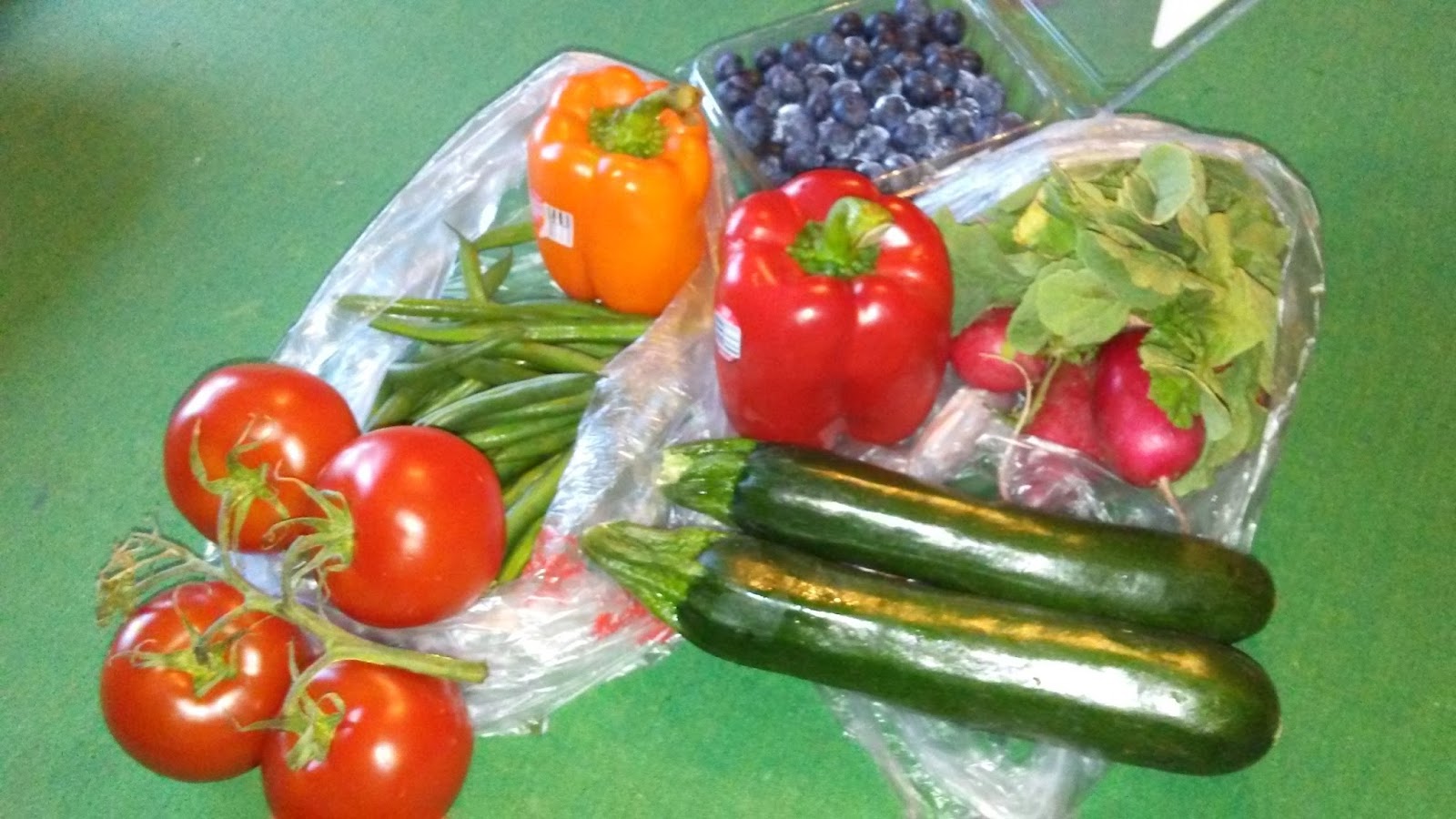
PRODUCE! You can see the blueberries in the back, then two bell peppers, one bunch of radishes, a pound or so of green beans, zucchini, and tomatoes. I had rebates for the peppers and zucchini via Ibotta. I also had a rebate for tomatoes through the app Checkout 51.
Snackies... The Wheat Thin crackers were on sale and I had a rebate available through Checkout 51. I had coupons for the Justin's nutbutter packets that should have made them free, but they resulted in an error message each time the cashier tried to use them. I ended up paying full price for each nutbutter packet and plan to write to the company for a refund due to the coupon problem. I also received a rebate on the Luna bar from both Ibotta and SavingStar and a coupon and a sale price resulting in my $1 Lunabar costing me only 25-cents! The pretzel bites and soda...no comment! My son actually bought the chips himself but gave me the cash and tossed them into our cart.
My work schedule makes it hard for me to prepare three meals per day every day for both of us, so my son gets more frozen foods than I care to admit. The Morning Star patties are for me though.
These next three pictures show my shopping and savings method. I write out a list of what's on sale from each store I frequent with the sale prices, item names, item sizes, and any limitations. Then I also mark (SC) if I have a store coupon, (C) if I have any other coupon, and then abbreviations for any apps that have rebates or offers on the items on my list. 

So, I might write:
  • $1 Luna Bar (C) (Ib) (S*) to indicate that Luna bars are on sale for $1 but I have a coupon plus rebates available from both Ibotta and Saving Star.

I also note the rebates I have selected from Ibotta, Saving Star, and Checkout 51. At the top of the page, I make a list of anything else on my shopping list. After I get home or get back to my car, depending on how many rebates I need to take care of or how many stops I've made, I process the rebates. For Ibotta, Saving Star, and Checkout 51 and my local stores, this involves scanning the barcodes on most items (the apps include the scanning mechanism) and taking pictures of the receipts. Ibotta pays out the fastests after scanning your items, but Ibotta and Checkout 51 both require that you accrue $20 before you can actually get the rebates sent to you. Saving Star has a threshold of $5 before you can request your rebates. 

I also recently started using Shopkick. I'm so new to it that I have yet to decide how useful it will be. It appears that you can get deals and savings through Shopkick, but I am far more interested in the fact that you can accumulate points (called "kicks") just by walking into certain stores or by scanning the bar codes on selected products. Right now I have 275 kicks. 

You can trade the points in for gift cards ranging from Starbucks to TJ Maxx/Homegoods/Marshalls to clothing stores to Wal-Mart. Some are available for as little as 500 kicks, but that is only for a $2 gift card. My current goal is 1250 kicks for a TJ Maxx/Homegoods/Marshalls gift card as we moved at the start of June and have lots of things to replace! Our move was far enough that we got rid of almost everything we owned before moving (sold, donated, or trashed everything!).

If you use Shopkick or Swagbucks and redeem your points or kicks for Starbuck's gift cards, be sure that you register one card and transfer all of your balances to it via Starbuck's! That way, every time you make a purchase using your Starbuck's gift card you can earn Star Rewards--points towards free drinks, food, and merchandise. Most of the time you earn 2 stars for every dollar spent, but there are monthly double reward days and other deals and specials that can greatly increase your stars and your potential for freebies. 

What other apps or saving programs do you utilize? I have downloaded a few others but either they don't have items available that I would use or they aren't as easy to navigate. 

Thursday, February 11, 2016

Money's tight and you're desperate: Part IV of V -- Cooking, kitchen, and pantry habits

Part 4 of 5: Cooking, kitchen, and pantry habits
When you're desperately broke: Part 4 of 5--Cooking, kitchen, and pantry habits
This five part series has covered a variety of topics and tips to consider when you are desperately broke, but today's post is going to focus in on your cooking, kitchen, and pantry habits. This post is NOT about grocery shopping, but it is related. To read more about my grocery shopping tips, click HERE.

STOP buying aluminum foil, parchment, plastic wrap, and Tupperware and its alternatives
Products such as aluminum foil, parchment, and plastic wrap are expensive. Even when you buy the cheap versions. When you run out, I want you to see how long you can go without replacing them. If you have Tupperware or similar food storage containers, when they break or get damaged, don't  go out and buy replacements. What alternatives can you find to how you use these items? A few ways that we get around using these things:
  • Save butter or margarine wrappers in your fridge and use them to grease baking sheets and baking dishes instead of using parchment. 
  • Save jars and washable food packaging with lids to use for food storage. I scored a free jar of pasta sauce a few months ago and rinsed and washed it well after we used the last of the sauce. I now use that jar to hold rice (bought in the bulk section at a great price from WinCo). I also use re-purposed  jars to store dry lentils, oatmeal, herbs and spices, and a wide variety of other dry goods in my cupboards. 
  • If you use a microwave to reheat food, use a plate to cover the food instead of plastic wrap. Also, be much more careful of how long you microwave food for to prevent spills and splatters to reduce the need for covers in the first place--can you heat, stir, and heat a little more to avoid splatters?
  • If you need to cover a pot and don't have a lid, use a plate for that too.
  • In the fridge or freezer, use your upcycled jars and other containers to package your food. Just be careful about how long you leave foods in the freezer in your upcycled containers and use them up before freezer burn has a chance to set in. Also, be very careful before placing glass containers in the freezer...you don't wan them to crack!
REUSE aluminum foil and wax paper
If you buy or have cereal at home, save the wax paper liners from the packaging. Carefully peel it open at the seems and wash it in the sink with a sponge and a little soapy water. Lay it out to dry, or lay it over your clothes drying rack to dry. Then, carefully fold it up and put int in a drawer for the next time you need wax paper.

Of course, also make sure that if you are buying cereal, that you are buying it ON SALE + using a COUPON + using a savings app or website like SavingStar or Ibotta. Or, buy store brands if they are cheaper!

If you still have aluminum foil, every time you use it, be very careful not to rip or tear it. After use, carefully wash it with a sponge and some soap and water and then dry and save it as well.

And, with any foil, wax paper, parchment, or plastic wrap, be careful to only use the amount that you need. Measure it and use scissors to cut it, if you necessary.

MINIMIZE your dishes, utensils, pots, and pans
How many plates do you have? Mugs? Spoons? Steak knives? Do you NEED all of them? If you pack some of your dishes, utensils, pots, and pans away you can reduce the amount of dish washing you have to do simply by eliminating excess. We are a family of two but had dish and utensil sets for EIGHT. When we needed a clean plate, we'd look in the cupboard first. We would put off washing dishes as long as we could as it's a chore we both really dislike. Ultimately, this habit was causing us to have to wash A LOT of dishes at a time which made us put off doing dishes even longer! It was totally counterproductive and it meant we used a lot more energy and water when we would finally wash the dishes. We'd also typically be a lot more unhappy than necessary.

We now have dishes for four in the cupboard, 8 spoons, and 4 of the rest of our utensils (we use spoons A LOT).

I also went through all of our cupboards and pulled out pots, pans, bake ware, and more that we either didn't use, were duplicates (causing us to use more than we needed and increasing the dish washing load), and so on. I also got rid of anything that was broken or unusable.

I did sell a few items, but the extra dishes and silverware that I kept are packed away in a closet and only get brought out a few times per year when we have company.

If you aren't sure how much to pack away or get rid of to reduce your energy costs associated with dish washing, start small. Can you pack away one mug and one set of silverware without anyone noticing or complaining? Keep going until you've hit the threshold of what you and your family can tolerate. I did it all at once though, and I noticed an immediate and significant drop in our water bill just from this single change!


Inventory your fridge, pantry, and freezer
You might need to eat some creative or weird meals, but nothing should be wasted — if you bought it, you should eat it unless it’s gone bad or is too far expired. If you find foods you bought a long while ago, consider never buying them again — if you bought it and didn’t ever eat it there was a reason why and that was wasted money.

At the moment, I happen to have a package of mushrooms that must be eaten in the next two to three days, as well as two tomatoes, and a bag of salad. I'll be having mushrooms and chopped tomatoes  cooked in some olive oil with pepper and some garlic powder for a snack, salad with mushrooms and tomatoes for lunch at work, mushrooms and tomato in an omlette for breakfast, and another salad for lunch tomorrow.

Do this inventory at least weekly. 

Inventory the food you throw away
Put a piece of paper on your fridge or cupboard and write down every piece of food you throw away. Then, after the list has grown, take a look at it. Was it leftovers, stuff that expired, stuff that went bad/got old/moldy? WHY did you throw it out? Make a plan to really minimize throwing away any food.

Every time you throw food in the trash, reflect on how much money you had to pay to buy that food. As it adds up, your shopping, inventorying, and eating habits should improve accordingly.

Food in the trash = money in the trash.

Have a leftovers night at least weekly
At least once per week have a leftovers or "clean out the fridge" night. Pull out all of your leftovers and let your family members choose from them for dinner. The crucial element is that you are eating the food that's already prepared or about to go bad and not cooking or buying something new. If you or your family hate leftovers, make a plan to minimize or eliminate them.

I once tutored for a family that would cook HUGE meals every night and then throw away more than HALF of what they had prepared because they all claimed to hate leftovers. On a couple of occasions they gave me the leftovers to take home. They made so much food that their leftovers translated to multiple meals for my son and I! I told the mom, in total seriousness, that I would give her a huge discount on my services in exchange for their nightly leftovers. She didn't believe me and never took me up on my offer.

Promptly refrigerate or freeze leftovers
If leftovers cause your family to overeat, promptly package the leftovers as soon as you re done cooking and pop them in the fridge or freezer as soon as they are cool enough.  If I know the dish I am making is going to have extra leftovers after everyone is served, I will portion those leftovers out into containers for lunch the next day. Four soups and things that are easily freezable, I portion the left overs out into single serving sizes so they are easy to thaw and reheat for a single meal. This minimizes food waste, minimizes additional cooking time, and keeps meals on hand for those hectic and crazy days when fast food or delivery seem easier (even when you can't afford them). Just be sure items are clearly labeled with  the item name and the date and eat them up before they go bad.


Read all of the posts in this series HERE, or for individual posts:

Read Part 1 HERE--Getting support, embracing free, food bank, and feminine hygiene.
Read Part II HERE -- Medications and healthcare, grocery shopping tips, and housing.
Read Part III HERE -- Utilities and transportation

Part V will cover laundry, toiletries, cleaning, and pet care

Monday, January 25, 2016

Tips to save on groceries

Hi all! Thanks for tuning in to learn more about how I save money on groceries.

First of all, in full disclosure, I have to say that I totally fell of of my own grocery savings plan and lost track of some of my own best habits over past two weeks. I picked up a respiratory virus that has caused my asthma to flare up and I've been a bit of a wreck as a result, not to mention allergies on top of all that! So, my end of January grocery recap is going to be pretty dismal for me. Sigh...but, I think that's an important reminder that everyone makes mistakes, has slip ups, or runs into detours. We ALL have our ups and downs, so when you are feeling down, just remember the rest of us have been there, done that and we're there rooting for you!

Anyhow, today I wanted to recap some of my favorite grocery tips. In THIS post, I mentioned taking part in the #moneylovechallenge hosted by Kate Northrup, author of Money: A Love Story. Well, today someone posted in the private Facebook group associated with the challenge about how she is struggling to get her grocery costs down. I brainstormed some of my favorite tips and thought I would share them here as well. Some are obvious, but others might not be. Some are also similar to the tips in THIS post, but there are a few that I didn't list previously.

Cook from scratch 80% of the time
As long as you are careful with your ingredients, your utilities, and so on, cooking from scratch can save you a lot of money. It is also almost always healthier. To make cooking from scratch economical, I do the following:
  • Only buy ingredients in quantities that I need.
  • Only cook in quantities we can and will eat.
  • Do most of my cooking on non-peak hours for our utilities (before noon or after 7pm on weekdays or anytime on weekends) to save on the cost of electricity.
  • Make double batches of our favorite recipes and portion out and freeze the second half before serving dinner.
  • Realize that cooking from scratch reduces sodium, additives, and other unhealthy junk so I am also protecting our health and potentially saving on the cost of future healthcare.
  • Keep a list of easy, go-to recipes that are inexpensive but filling and make them regularly.
Compare sales fliers for the four or five stores nearby
We are lucky enough to live in very close proximity to a wide variety of grocery stores. I know that one store always has the best produce, another the best meats, and another the most variety overall. One has the best bulk foods sections. However, I still compare the sales fliers each week to determine who has the best overall sales prices and if it would be worth it or not to go to only one store versus multiple stores. Some weeks the savings are worth going to multiple stores and other weeks the savings are not. One weeks when it is worth going to multiple stores, I space the grocery trips out and combine them with other errands or stop at a different store each day on my way home from work.

Inventory my fridge and pantry BEFORE going to the store
This includes organizing my fridge, freezer, and cupboards regularly. If you can see what you have, you are less likely to over or under buy. When my son and I lived with my mom, I discovered that my mom had five full sized, unopened bottles of ketchup. Did she find a great deal? Nope. Did she have a habit of buying in bulk? Nope. What she did was put them in the cupboard and just shove more and more into the cupboard so that she couldn't see everything clearly. She would end up forgetting she already had ketchup and buy more. It was a waste of money for something that was rarely used in our house. Inventorying also allows you to meal plan before you even think of going to the store. Can you get another few days of filling meals out of what is on hand?

Make my list and meal plan AFTER comparing sales fliers and doing my inventory
If you are trying to save on groceries, there is no point in meal planning without first seeing what you have on hand and then seeing what's on sale. How many meals can you get out of what you already have and how many more can you make with what's on sale?

Use SavingStar and Ibotta or other grocery rebate apps
I talked about SavingStar HERE, but also just found out that you can actually use multiple grocery saving apps at the same time and on the same products! I haven't using multiple apps on the same purchases yet, but so far this month, I've got more $8.90 in rebates from SavingStar and just qualified for a 25-cent rebate through Ibotta. SavingStar only has $5 threshold to cash out via PayPal, but Ibotta has a $20 threshold. These apps do require some time as you have to select offers, input product codes (scan the bar codes or manually input the UPC or product code numbers), scan your receipts, and then wait for the rebates to be processed. SavingStar also periodically has free-after-rebate items, and if you take advantage of enough offers, you qualify for additional freebies and offers.
  • Sign up for SavingStar HERE.
  • Sign up for Ibotta HERE.
SavingStar is pretty straightforward, but Ibotta takes a little figuring out...I'm not totally there yet!

Selectively use coupons
I don't use a lot of coupons, but when I do, I try to match them with SavingStar offers or grocery sales, ideally with BOTH. It's really cool when you can match a sale price + a SavingStar rebate + a coupon! I get most of my coupons through the mail by being signed up for my local favorite grocery store's savings card program, but I also use printable coupons from Swagbucks (found under the Shop link). I get coupons via Swagbucks because you can sometimes earn points through Swagbucks if you redeem enough coupons and then you can use those points to get giftcards once you've accumulated enough (I paid for my son's entire Christmas last year and the year before with Amazon credit accumulated through Swagbucks!). Keep in mind though that it's not a deal if you are using a coupon to buy something you wouldn't normally purchase or eat, hence the use of "selectively."

Eat BEFORE grocery shopping
I eat a filling snack before going to the grocery store and I take a drink from home--usually coffee--to help me avoid temptations and impulse purchases. Over time, I've realized that grocery shopping hungry usually means buying things that I think I want instead of what I really want or need. Pretty basic trick, but it works!

Review my cart before checkout
Before I get in line, I review the items in my care and compare them to my grocery list. If I see anything not on my list or that I really didn't need, I remove it before I get in line. I usually just set it in a different part of the cart and then give it to the cashier and tell them I changed my mind about that item. It's not a big deal--they have it happen all the time and most stores are set up to have a runner or a store clerk whose job is to make a sweep of the checkout area for unwanted items and to to return them to the shelves. 

Track food I THROW OUT
Almost all of us are guilty of wasting money on groceries simply by letting food rot. We then throw it out. I keep a list of the food I throw out, always striving for less and less food waste. Throwing out food is like throwing away money. If I notice that I am consistently throwing away the same foods over and over, I try to either buy that food in smaller quantities or I simply stop buying it. 

Review produce on hand
Every few days I review the produce in our fridge and pantry. I look for things that are going to go bad if not eaten in the next few days and make sure I incorporate those into our meal plan. Soups and stews are a great way to use up a lot of vegetables and pies, crumbles, crisps, and smoothies are great for using up fruit. 

Selectively shop for specialty items
My son and I have food allergies so we use specialty items like sunflower seed butter instead of peanut butter and rice milk instead of cow's milk. Both are quite expensive at the regular grocery store and also at the discount grocery store. Instead, I buy them at Trader Joe's, Whole Foods, or Costco. They cost significantly less at these stores since Trader Joe's and Whole Foods cater to specialty markets and Costco deals in bulk. I save enough on specialty items like these that it is worth the extra drive or trip.


What are your favorite grocery savings tips?

Wednesday, January 6, 2016

January 2016: A peek inside my kitchen (how I organize to save money on groceries)

kitchen organization
I see a lot of grocery savings posts and cooking posts that seem inspiring, but I often wonder, "What did they already have in their pantry and fridge??? How can they buy those particular things and no xyz and still eat well?" I also see perfect, beautiful, clean kitchens--I don't know about you, but my kitchen doesn't look like that on most days!

So, here is a peek inside my kitchen on January 6th, 2016. I'm showing you my messy counters, my before pictures of my cupboards, fridge, and freezer, and afters of those same areas.

After watching a video by The Former Mrs. Jones on YouTube about her grocery budget and a recent grocery trip followed by a clip of her cleaning her kitchen and some info on her meal plan for the next two weeks, I decided to tackle some similar stuff.

Ready?

Set.

Go...

Here's an overview of my kitchen--we cook fairly frequently and so we almost always have dishes to wash. We've gotten a lot better at washing dishes more often and all of these dishes on the counter and in the sink should be washed by end of day today. We also only wash by hand, turning the water OFF while we scrub. Hand washing, even though we have a dishwasher, saves us a ton on our electric bill--so much that the added time required to hand wash is well worth it! Often we wash dishes while watching Netflix to make the time pass a little faster.
the frugal kitchen
And a few cupboards, the fridge, and pantry...

Hanging on the back of my pantry door, I have a shoe organizer. The top two rows of pockets hold medications, bandages, and health stuff. The third row from the top holds instant oatmeal packets and breakfast drink mix (all given to us for FREE) and some leftover Halloween candy. The fourth row holds my son's breakfast and snack bars. The fifth row holds a couple of my snacks (bulk purchased wasabi peas, Sesame Snaps), a pocket with paperclips and binder clips, and a pocket with napkins, plastic cutlery, and straws that we've picked up randomly. The bottom two rows hold dog supplies (heart worm medication, ear wash for one of our dogs, travel brochures from places we hope to visit in the next few years, a pouch of unopened mix-ins that I use in smoothies, and a roll of trash bags.

THIS over the door pocket shoe organizer is very similar to and several dollars LESS expensive than the one we bought.
frugal kitchen organization
In the cupboards and pantry shelf--it might not look like a did a whole ton of organizing on the pantry shelf or kitchen cupboard, but it feels like I did! I pulled a few canned items from random spots and put them on the pantry shelf and grouped items together. I also pulled two items out of the pantry that we won't eat (one was given to us and the other I bought on a whim and I will donate both).

In the cupboard, I pulled together boxed items, organized my herbs and spices a little better, pulled cereal out of its boxes (the boxes were too big and I couldn't close the door completely), grouped pasta together, grouped cereal together, and few other little things.
kitchen organization
In the fridge and freezer, there wasn't a whole lot to do other than reorganize so I would know what I had. I couldn't clearly see what was in the freezer for the most part. While I don't have it organized in the most energy efficient manner, I do have it organized so I know what's there and where things are. For example, the door of the freezer is mostly filled with fruits and veggies--all fruits gathered together and veggies together. The ice cube tray actually doesn't have ice in it, but rather frozen pureed bananas that I use in smoothies. When bananas go on sale, I buy a bunch, puree them and freeze them.

In the fridge, I pulled together condiments and small jarred items, put food that needs to be eaten today on the top shelf, pulled together my son's Christmas candy leftovers, and then pulled together some other leftovers, veggies, and so on. I also have a container on the bottom shelf filled with leftover rice that we give to one of my dogs (she has digestive issues and plain rice seems to help her a lot--consult your vet before changing your dog's diet though!).
fridge and freezer organization
We have A LOT of condiments, sauces, and other small stuff in our fridge. I don't remember where I saw it, but someone posted a picture on social media showing how they used the bottom half of an egg carton to old condiments upside down so the dregs in the bottom of the jars would be pulled by gravity towards the lids and openings. BRILLIANT, right? I cut the bottom of an egg carton down a little bit so it would fit in our fridge door and popped our mustards, ketchup, and horseradish sauce into it. Works beautifully!
fridge door organization
Now that I know what I have on hand, I can meal plan, make my grocery list for this coming weekend to fill in the gaps, and so on. Doing this kind of cleaning up and organizing at least every other month, if not monthly, allows me to save in the following ways:
  • I don't double or triple buy unless it is strategic (like maybe there's a too good to be true sale price on something) because I know what we have on hand.
  • I can group things in the fridge according to when they need to be eaten (TODAY items always go on the top shelf) so we waste a lot less food.
  • I can STOP buying things we won't eat--if it's non-perishable that's been hanging around for months or a perishable that is going bad, I probably shouldn't buy them again.
  • I can adjust quantities on my grocery list before going to the store so I don't over or under buy.
  • I can create a meal plan (I do three days at a time) easily knowing what's on hand and not worry about needing to go to the store, thus I minimize impulse buying--you know how it is: you go in for one item and leave the store with four or five items.
My meal plan for the next three days:

Today:
  • Breakfast: oatmeal with berries, coffee, tea
  • Lunch: leftover pasta with cheese sauce and leftover taco bowl for JP; leftover pasta with marinara sauce and salad for me
  • Dinner: mini meatballs with pasta and marinara sauce; salad; garlic bread
Tomorrow: 
  • Breakfast: waffles, berries
  • Lunch: dad and stepmom are taking us out to eat
  • Dinner: tomato soup with hash browns (oven needs fixed before we do oven fries)

Two days from now:

  • Breakfast: oatmeal, coffee, tea
  • Lunch: whole fruit smoothies, hard boiled eggs for both of us; salad and tomatoes for me; Pasta Roni for JP
  • Dinner: veggie soup; garlic bread
How do you keep your kitchen organized and how does it help you financially?

~*~*~*~*~

Also, what are you watching on Netflix that you LOVE? I'm about to finish "Nurse Jackie" and need some suggestions. I've already watched "Jessica Jones" which I loved and also recently finished "Sons of Anarchy." Thanks in advance for any suggestions!

**Posts on this blog may contain affiliate links.**

Monday, January 4, 2016

Tracking spending and grocery shopping

tracking spending and groceries

Tracking my spending should be easy, but it's not. I find it rather difficult and always have. I think combining tracking spending with accountability with a spending freeze will make it a bit easier.

That said, today, I  spent $3.56 on take away coffee because I had failed to prepare adequately for my day. I made a lunch last night but didn't make any coffee or fill my water bottle. I also didn't set out anything for breakfast for this morning -- all things I should have done last night to prepare for a day on which I have to work.

What makes THIS time different?
I've been through many cycles of tracking, slipping up, and then giving up. But this is the first time I've ever felt like I have a chance of truly paying off my debts, saving a significant amount of money, and turning my financial life around.

This time, I have a plan. It didn't work perfectly today, but it worked better than it ever has before. I'm working on three days at a time for my spending freeze, looking ahead over the upcoming three days for possible pitfalls and other temptations, and taking steps to achieve my goals.

Yes, I slipped up today. I will probably have other slip ups in the future, but already my slip ups are far smaller than they ever have been before. I took a lunch to work. I took my water bottle even though I forgot to fill it. In the past, my slip up would have cost me a lot more than $3.56. It would have been more like $13.56 today followed by a slide into $13.56 every day.

Tomorrow, I don't have work. I have no reason to leave the house really except to take my dogs out for a walk. I have a meal plan in place for tomorrow too.

Tracking and improving my grocery budget:
I am proud to say though that I went to the grocery store yesterday with my son in tow -- usually a mistake -- and managed to spend a lot less than I usually would in that situation. I didn't save as much as I normally would, but still enough that I feel like I did a good job. Last night, I took the following steps to save on my groceries:

  1. Evaluated my needs -- what was I out of, what was I too low on not to buy and made a list of those items
  2. Evaluated the sales flyer from the nearest store and compared my list against the flyer
  3. Evaluated available deals on Saving Star and activated deals that fit my list and also anticipated future needs
  4. Evaluated my coupons and compared them to my list and Saving Star deals
  5. Talked to my son about our budget and grocery needs vs wants
  6. Allowed my son two wants that were on sale AND available deals on Saving Star AND that I had coupons for 
  7. Allowed myself one want that was on sale AND an available deal on Saving Star AND that I had a coupon for
Here's the breakdown of my purchase, before coupons, after coupons, and after Saving Star:
  • Original subtotal: $65.72
  • After club card savings and coupons: $47.94
  • After Saving Star rewards (pending approval): $45.04
If you haven't used Saving Star, you activate various offers (like say $5 back on a $15 Angel Soft toilet paper purchase). You submit bar code numbers for the qualifying items in your purchase and then scan and upload your receipt with those items on it. They evaluate your bar code numbers and receipt and either approve or don't approve the purchases. If they approve, you are given a rebate in the offer amounts. Once you reach $5 or more, you have the option to keep accumulating or to have the funds transferred to you via PayPal.

In the past, I used to be able to save 60% on a grocery purchase easily without going extreme on the couponing. My process, both then and now takes less than 30 minutes per week, not counting the actual shopping. Unfortunately, in the past my local store used to double coupons but they stopped quite some time ago.

Now that I've done a bit of grocery shopping, we'll be working meal plans and eating through everything before we go grocery shopping again, even if it means eating some really weird meals.

How are you saving on your groceries?

Wednesday, December 23, 2015

8 Rules to Minimize Food Waste at Home

Reduce food waste


My original goal had been to post daily in my adventures towards debt freedom.

I haven’t done that, my reader.

That last post about depression and money sort of wiped me out emotionally! I’m glad I wrote it, but it really did a number on me and put me into a funk again.

I’m starting to pull out of it though and wanted to share with you a couple of links and some food-money rules that we practice. I’ve mentioned groceries and food before – click HERE to read related posts.

First, I was scrolling through my Facebook feed when I came across a link via Goop (yes, I follow Goop despite the exorbitant excesses they often push) about “make do” pies. I didn’t follow that link, but instead went to my good friend Google and asked, “Google, what are make do pies?” (Actually, I just typed “make do pies” into my search bar WITH the quotation marks so Google would search for my exact phrase…).

I turned up some interesting articles that I thought you might enjoy:


Now, my own “make do” cooking and food rules:
#1. ~ If it’s in your fridge, freezer or cupboard, plan to eat it, trade it, or donate it. 
If you find yourself donating foods because you simply won’t eat them, STOP BUYING THOSE FOODS! Chances are if you won’t eat it, the person receiving it may not want to eat it either. If you want to donate food, donate things you actually like and think someone else would also enjoy. Also, donate food throughout the year, not just around Thanksgiving and the winter holidays. Plus, if you are buying foods you and no one else in your home will eat, you are wasting money.

#2. ~ Have a plan to prevent spoiling
If you think something will go bad before you can consume it, figure out if it is freezable, and if it is make sure you package it properly and make a plan to use it in the future. HERE are some tips on freezing food from the BBC's Good Food blog.

#3. ~  Have a weekly leftovers night
At least once per week have a fridge clean-out/leftovers dinner night. Pull out all of the leftovers, bits and pieces that are too small for a full serving, and things that need to be eaten soon to avoid spoiling. Can you make anything new out of any of it? If so, do that. If not, let everyone pick and choose what they want to eat. The only rule is this: if you select something from the options you then are obligated to eating it! No throwing it out!

Here's an example of a past "make do" fridge clean out meal:
leftovers meals
The night we had this meal, we had enough leftovers for two servings of rice, a serving of sausage each, a serving of spinach each, one egg that I scrambled and gave to my son, leftover roasted red peppers that I ate, and baby carrots for both of us. We both like spinach, but I prefer it cooked while my son prefers his raw. Super easy to cook mine down in the same pan I used to scramble the egg. We used up leftovers, used up spinach before it went bad, and both had full tummies.
#4. ~ Put a lid on it

COVER everything before putting leftovers in the fridge. My son has a bad habit of putting uncovered leftovers in the fridge so that by the time I discover them the next day they are dried out or otherwise gross (dried out, stale rice anyone???). Also, handy tip for leftover rice: If you remove the lid and the rice seems a little dry, just add a teaspoon or two of water per serving and heat in the microwave for a minute or two while covered. The rice should soften up a little bit. Experiment with how much water you need.

#5. ~ Freeze your stale bread 
If you have bread that is going stale, toss it in a zip top baggie or a plastic container with a lid and put it in the freezer. Next time you need bread crumbs, pull it out and grind or tear it up. We also freeze the end pieces. Thaw them and use them to make stuffing, bread pudding, or croutons.

#6. ~ Freeze veggie ends and peels and make broth
Rinse well and then toss veggie peelings, onion skins, carrot and celery ends into a plastic container with a lid and put it in the freezer. When it’s full, use them as the base of a good home made broth. I don't follow a recipe when making broth, but my method is to put on a pot of boiling water, dump in my veggie scraps, add some salt, pepper, garlic powder, bay leaf, and whatever other seasonings sound good at the moment (I really like thyme) and bring it all to a rolling boil. Then, cover and turn the heat down to a simmer and let it bubble away for a few hours. Carefully taste it periodically and adjust seasonings or add more water as needed. When you think it's done, turn off the heat and let it cool. Then, strain out all the veggie scraps and put your broth in storage containers for the fridge or freezer. Yum!

#7. ~ Don't buy foods you don't like even on sale
As mentioned above, don’t buy stuff you don’t like – even if it’s at a steal of a price. If you don’t like it, you won’t eat. If you don’t eat it, you haven’t saved anything no matter how great the sale was.

#8. ~ Keep a running list of the food you throw away
This may seem odd, but writing down exactly what you are throwing away can be eye opening. You may think you are throwing away very little food when really you're throwing away several meals worth every month. Make a habit of writing down the food you throw away and then review your list periodically. If you are throwing away the same things over and over, consider no longer buying those items. If you are throwing away a lot regularly, perhaps reconsider your overall grocery and meal planning strategy and how you might cut back.

What are your family’s food and grocery rules for minimizing waste? Do you have a favorite “make do” recipe?

~*~*~*~*~
DEBT TRACKING:
Original total: $110,000
Paid off yesterday: $10
New total: $109,940 
 
~*~*~*~*~
One way that I'm working towards paying off my debt is by using the cash envelope method for budgeting. To stay on track, I created my own cash envelopes that double as coloring pages. Each one has space on the front for the name of the envelope's category, a money mantra, and three category priorities. Get yours in my Etsy shop HERE.
envelope budgeting

Saturday, December 12, 2015

Zero food waste and my budget


I grew up in a home where a lot of food got wasted -- A LOT. As new food was bought, older food was simply pushed to the back of the fridge, freezer, and cupboards to rot. Leftovers were only occasionally eaten and no care was taken to look at prices when grocery shopping nor were efforts made before shopping to save money (no couponing, no looking over weekly sales ads, no price comparisons).

In some ways, I was very lucky to grow up that way -- I never went hungry and I never feared going hungry.

In other ways though, that type of environment taught me nothing about waste, keeping a budget, or money skills.

It has taken me a very long time to learn any money skills at all or how my food and grocery habits could impact my budget. In fact, although I made great strides after moving out and having a child of my own, it wasn't until my son and I moved back in with my mom several years later that I really started to notice how my family's bad food/grocery habits during my childhood affected my food-related money choices. I love my mom dearly and am so grateful that we were able to move in with her during a time of dire need, but we had very different habits and very different budgets. My mom was financially stable enough to continue to not worry about money, but my budget was extremely tight. I had to weigh my options at the grocery store and be careful that I made our money and food stretch in order to make ends meet and get ahead.

The final straw was when I realized how often food I bought with my own money was getting shoved to the back of the fridge, freezer, and cupboards when my mom bought food. Sometimes my groceries would get smashed so that when I found them they weren't really usable -- like a tomato with a heavy package placed on top of it. I tried talking to my mom about the problem which helped briefly. I tried using hard plastic containers with lids with minor success. I tried a number of other options.

Eventually, my son and I moved out so that I could go to graduate school and I was able to re-implement many of my frugal habits, including minimizing food waste. However, lately I've found both my son and I slip-sliding into bad habits again.

Today, I threw away a half bunch of celery, half bag of salad, and a serving of homemade chana masala. That's not a whole lot, but it still translates to throwing money in the trash. I also realized that I have asparagus that needs to be eaten in the next two days and two apples that will need to be eaten soon as well.

While I may not have cleared out a lot of food waste today, I wish I'd formulated a plan to eat those foods instead. Every time you throw away food, you have to spend more money to replace it. And, if you let THAT food go to waste? Well, more money wasted and more money having to be spent to replace the wasted food again. And, on and on and on...

This week, I'll be hyper focused on minimizing food waste to improve my budget. And, as a side benefit, because I've been buying mostly WHOLE, UNPROCESSED foods, I'm also benefiting our health in the long term which then translates to fewer medical costs over time.

{{I'll do a post in the future about how I save money at the grocery store -- last week, I saved 60% without being super extreme!}}

My zero food waste plans for this week:
  • Take my own lunch/snacks to work daily
  • Take advantage of free breakfast and lunch at work when my schedule and the meal schedule match up
  • Oatmeal, pancakes, waffles for breakfast daily for both of us
  • Apple fries for dessert tomorrow night to use up the two apples mentioned above
  • Leftovers for dinner tomorrow night (minestrone soup from Thug Kitchen* cookbook -- insanely good!)
  • Huge batch of homemade broth from veggie scraps I've been saving in a container in the freezer (it's basically FREE other than the electricity to run the stove and water and soap to wash the dishes! Just the scraps, water, and some seasoning!)
  • Asparagus fries as a snack tomorrow night
  • Homemade tortilla soup (also from Thug Kitchen) on Monday night
  • Evaluate perishables daily and meal plan for the following two to three days based on what's about to go bad
How do you handle food waste, meal planning, and your grocery budget?  


Yesterday's post: Paying off debt one penny at a time
Tomorrow's post: How bicycle commuting is saving me money.
And two days from now: How I'm using coloring to motivate my debt reduction

DEBT TRACKING:
Original total: $110,000
Paid off yesterday: $50
New total: $109,950


*Thug Kitchen is a vegan cookbook and IT IS FREAKING AWESOME! Even my son, a teenager who loves meat, thinks the recipes are outstanding. If you eat meat, consider cutting back -- it can save you a ton of money with some practice. However, if you are sensitive to swearing, this cookbook isn't for you, no matter how great the recipes are! It is filled to the gills with F-bombs.
http://www.amazon.com/gp/product/1623363586/ref=as_li_qf_sp_asin_il_tl?ie=UTF8&camp=1789&creative=9325&creativeASIN=1623363586&linkCode=as2&tag=mandj-20&linkId=23SZRWFWPMBY6FHU

This post may include affiliate links.